

Health Library
Dehydration
Vomiting - dehydration; Diarrhea - dehydration; Diabetes - dehydration; Stomach flu - dehydration; Gastroenteritis - dehydration; Excessive sweating - dehydration
Dehydration occurs when your body does not have as much water and fluids as it needs.
Dehydration can be mild, moderate, or severe, based on how much of your body's fluid is lost or not replaced. Severe dehydration is a life-threatening emergency.
Images
I Would Like to Learn About:
Causes
You can become dehydrated if you lose too much fluid, do not drink enough water or fluids, or both.
Your body may lose a lot of fluid from:
- Sweating too much, for example, from exercising in hot weather
- Fever
- Vomiting or diarrhea
- Urinating too much (uncontrolled diabetes or some medicines, like diuretics, can cause you to urinate a lot)
You might not drink enough fluids because:
- You do not feel like eating or drinking because you are sick
- You are nauseated
- You have a sore throat or mouth sores
Older adults and people with certain diseases, such as diabetes, are also at higher risk for dehydration.
Symptoms
Signs of mild to moderate dehydration include:
- Thirst
- Dry or sticky mouth
- Not urinating much
- Darker yellow urine
- Dry, cool skin
- Headache
- Muscle cramps
Signs of severe dehydration include:
- Not urinating, or very dark yellow or amber-colored urine
- Dry, shriveled skin
- Irritability or confusion
- Dizziness or lightheadedness
- Rapid heartbeat
- Rapid breathing
- Sunken eyes
- Listlessness
- Shock (not enough blood flow through the body)
- Unconsciousness or delirium
Exams and Tests
Your health care provider will look for these signs of dehydration:
- Low blood pressure.
- Blood pressure that drops when you stand up after lying down.
- White fingertips that do not return to a pink color after your provider presses the fingertip.
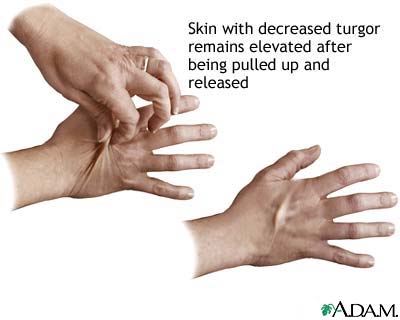
- Skin that is not as elastic as normal. When the provider pinches it into a fold, it may slowly sag back into place. Normally, skin springs back right away.
- Rapid heart rate.
Your provider may do lab tests such as:
- Blood tests to check kidney function
- Urine tests to see what may be causing dehydration
- Other tests to see what may be causing dehydration (for example, blood sugar test for diabetes)
Treatment
To treat dehydration:
- Try sipping water or sucking on ice cubes.
- Try drinking water or sports drinks that contain electrolytes.
- Do not take salt tablets. They can cause serious complications.
- Ask your provider what you should eat if you have diarrhea.
For more severe dehydration or heat emergency, you may need to stay in a hospital and receive fluid through a vein (IV). Your provider will also treat the cause of the dehydration.
Dehydration caused by a stomach or intestinal virus should get better on its own after a few days.
Outlook (Prognosis)
If you notice signs of dehydration and treat it quickly, you should recover completely.
Possible Complications
Untreated severe dehydration may cause:
- Death
- Permanent brain damage
- Seizures
When to Contact a Medical Professional
You should call 911 or the local emergency number if:
- The person loses consciousness at any time.
- There is any other change in the person's alertness (for example, confusion or seizures).
- The person has a fever over 102°F (38.8°C).
- You notice symptoms of heatstroke (such as rapid pulse or rapid breathing).
- The person's condition does not improve or gets worse despite treatment.
Prevention
To prevent dehydration:
- Drink plenty of fluids every day, even when you are well. Drink more when the weather is hot or you are exercising.
- If anyone in your family is ill, pay attention to how much they are able to drink. Pay close attention to children and older adults.
- Anyone with a fever, vomiting, or diarrhea should drink plenty of fluids. Do not wait for signs of dehydration.
- If you think you or someone in your family may become dehydrated, call your provider. Do this before the person becomes dehydrated.
Related Information
Nausea and vomiting – adultsDiarrhea
Urination - excessive amount
Pharyngitis - sore throat
Trench mouth
Seizures
References
Kenefick RW, Cheuvront SN, Leon LR, O'Brien KK. Dehydration and rehydration. In: Auerbach PS, Cushing TA, Harris NS, eds. Auerbach's Wilderness Medicine. 7th ed. Philadelphia, PA: Elsevier; 2017:chap 89.
Kliegman RM, St. Geme JW, Blum NJ, et al. Electrolyte and acid-base disorders. In: Kliegman RM, St. Geme JW, Blum NJ, et al, eds. Nelson Textbook of Pediatrics. 22ndt ed. Philadelphia, PA: Elsevier; 2025:chap 73.
Padlipsky P, White W. Pediatric infectious diarrheal disease and dehydration. In: Walls RM, ed. Rosen's Emergency Medicine: Concepts and Clinical Practice. 10th ed. Philadelphia, PA: Elsevier; 2023:chap 167.
BACK TO TOPReview Date: 7/1/2025
Reviewed By: Charles I. Schwartz, MD, FAAP, Clinical Assistant Professor of Pediatrics, Perelman School of Medicine at the University of Pennsylvania, General Pediatrician at PennCare for Kids, Phoenixville, PA. Also reviewed by David C. Dugdale, MD, Medical Director, Brenda Conaway, Editorial Director, and the A.D.A.M. Editorial team.
 | A.D.A.M., Inc. is accredited by URAC, for Health Content Provider (www.urac.org). URAC's accreditation program is an independent audit to verify that A.D.A.M. follows rigorous standards of quality and accountability. A.D.A.M. is among the first to achieve this important distinction for online health information and services. Learn more about A.D.A.M.'s editorial policy, editorial process and privacy policy. A.D.A.M. is also a founding member of Hi-Ethics. This site complies with the HONcode standard for trustworthy health information: verify here. |
The information provided herein should not be used during any medical emergency or for the diagnosis or treatment of any medical condition. A licensed medical professional should be consulted for diagnosis and treatment of any and all medical conditions. Links to other sites are provided for information only -- they do not constitute endorsements of those other sites. No warranty of any kind, either expressed or implied, is made as to the accuracy, reliability, timeliness, or correctness of any translations made by a third-party service of the information provided herein into any other language.
© 1997-
2026 A.D.A.M., a business unit of Ebix, Inc. Any duplication or distribution of the information contained herein is strictly prohibited.
All content on this site including text, images, graphics, audio, video, data, metadata, and compilations is protected by copyright and other intellectual property laws. You may view the content for personal, noncommercial use. Any other use requires prior written consent from Ebix. You may not copy, reproduce, distribute, transmit, display, publish, reverse-engineer, adapt, modify, store beyond ordinary browser caching, index, mine, scrape, or create derivative works from this content. You may not use automated tools to access or extract content, including to create embeddings, vectors, datasets, or indexes for retrieval systems. Use of any content for training, fine-tuning, calibrating, testing, evaluating, or improving AI systems of any kind is prohibited without express written consent. This includes large language models, machine learning models, neural networks, generative systems, retrieval-augmented systems, and any software that ingests content to produce outputs. Any unauthorized use of the content including AI-related use is a violation of our rights and may result in legal action, damages, and statutory penalties to the fullest extent permitted by law. Ebix reserves the right to enforce its rights through legal, technological, and contractual measures.
